Your plan is to enjoy your retirement years — and we’re here to help. Saving for your future using an employer-sponsored retirement plan is a powerful first step in making that happen.

12/08/2025
Preparing for the SECURE 2.0 Act Roth Catch-Up Mandate
As the January 1, 2026, effective date approaches, here’s what you need to know and do to prepare for the new Roth catch-up contribution requirements.
What Is the SECURE 2.0 Act Roth Catch-Up Provision?
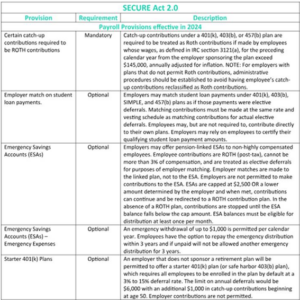
The SECURE 2.0 Act requires employees age 50 and older, who earned more than $150,000 in Social Security taxable wages in the prior year, to make all catch-up contributions on a Roth (after-tax) basis. Employees that meet the criteria are defined as Roth Catch-up Required (“RCR”) employees.
Who is affected?
- Employees age 50+ with US Social Security taxable wages above $150,000 in the prior year.
What’s changing?
- Pre-tax catch-up contributions are no longer allowed. All catch-up contributions must be Roth (after-tax).
Employer Requirements
- Employers may want to ensure their retirement plans include a Roth option. Without it, all RCR employees will not be permitted to make catch-up contributions thus avoiding the Roth mandate altogether.
Automatic Spillover in UKG Pro
- Beginning in 2026, UKG Pro will support spillover functionality. Once an employee reaches the elective deferral base limit ($23,500 for 2025), catch-up contributions will automatically spill into a Roth plan if configured. This will require a one-time configuration in the Benefit/Deduction plans business rule. If a Roth catch-up plan is not configured, the pre-tax deduction will stop at the base limit.
⚠️ Action Required!
- Confirm Roth contribution options exist in your plan with your 401K Plan Administrators.
- Coordinate with your recordkeeper/payroll provider to ensure systems are updated and your plan can accommodate “Deeming elections”
NOTE: Failure to coordinate with your plan recordkeeper may result in your plan disallowing catch-up contributions for High FICA Wage Earners beginning January 1,2026
- Begin employee communication early to ensure smooth compliance. Review the attached documentation on how to add your “deeming” plans to applicable codes, and FAQ’s about the Roth Secure 2.0 Provision
If you are a MEP plan adopter, PlanSource has already been in touch with TransAmerica and we will be reaching out to coordinate additional actions outlined above/below.
What You Need to Do in UKG Pro
- Decide on “Deeming Elections” (qualified automatic contribution arrangements) with your recordkeeper. Please review the helpful FAQ (attached) on information regarding “deeming” elections. Adopting “deeming” elections will allow you to remain more easily compliant to the Secure 2.0 provisions.
NOTE: Your record keeper will have additional requirements to notify them on how you plan to administer the change, the information below can be used to accommodate this process more easily.
- Run the SECURE 2.0 Act Contribution Eligibility Business Intelligence Report to identify RCR employees. Coming soon!
- Add your plan ID to the report and use the information to upload RCR employees to your plan recordkeeper. Contact your record keeper for instructions on how to upload this file.
- Configure Spillovers in Deduction/Benefit Plans (only if deeming employee elections. Consult with your recordkeeper about deeming). The IRS allows an employer plan to adopt deemed Roth elections where RCR employees’ pre-tax catch-up contribution elections are automatically treated as Roth catch-up contribution elections.
- Communicate with employees about the Roth-only rule starting in 2026.
10/24/2024
We have an update regarding recent developments to the Secure 2.0 implementation into UKG Pro. Here are some of the actions you can take to prepare for the upcoming changes introduced by the Secure 2.0 Act.
- Assess impacts — Begin to assess the impact of the changes required by SECURE 2.0 Act on your retirement plans.
- Review optional provisions — Determine which optional provisions of the SECURE 2.0 Act you may want to incorporate into your plans and address internal operational compliance for these provisions.
- Get professional counsel — Once the above assessments are completed, begin to consult with your legal counsel and/or plan administrators on the timing of plan amendments, given that the Department of the Treasury may issue additional guidance.
- Create a communications plan — Consider the timing and content of employee communications and updates needed to your summary plan descriptions.
Below are the Provisions coming with each fiscal year thus far – UKG has provided the following FAQ and documentation regarding the increased catch-up implementation. As it stands, no manual modification will be required to implement the new catch-up on existing catch-up tax categories on your 401K Deductions.
- Starting with pay dates of 1/1/25 and later, the higher “super catch-up” limits are automatically applied to any deferred compensation deduction code having an applicable deferred compensation deduction tax category when the employee is age 60 to 63 as of December 31 of the current payroll year. The applicable tax categories are:
-
- 401(k) Catch Up Contribution
- Sec. 401k Comb. Base and Catchup
- Roth 401(k) Catch-up
- Roth 401k Combined
- 403 Catch Up Contribution
- Sec. 403b Comb. Base and Catchup
- Roth 403 Catch-up
- Roth 403(b) Combined
- 457 Catch Up Contribution
- Sec. 457 Comb. Base and Catchup
- 457 Roth Catch Up Contribution
- 457b Catch Up Contribution
- Sec. 457b Comb. Base and Catch Up
- Roth Section 457(b) combined
- SIMPLE Catch Up Contribution
- SIMPLE Combined Base and Catchup
- 408 Catch-up Contribution
- Sec. 408 Comb. Base and Catch-up
-
Please note your deduction must have a catch-up tax category assigned in order for the limit to apply. The HCM Service Team will communicate with you as more information is received.
FAQ Higher Catch-Up Contributions
Higher Catch-Up Documentation – UKG Pro
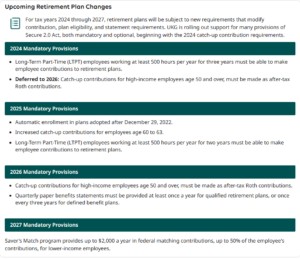
We have an update regarding Secure 2.0 and the previously reported required provision effective in 2024. The anticipated required implementation of the Roth Catch-Up Provision, for participants earning $145,000 or greater, has been delayed.
The IRS has granted a 2-year extension to allow for an administrative transition period. The requirement must now be implemented beginning after December 31, 2025.
PlanSource will continue to monitor developments and share them as we receive them. If you are a member of the PlanSource MEP plan, our 401k team will provide additional support and details, as this requirement continues to develop. If you maintain an individual 401k plan, we recommend you work directly with your plan advisors and third-party record keepers for the most up-to-date and relevant information impacting the specifics of your plan.